

Space geekery...
...jumping on the Artemis II space wagon to dive into "NASA-inspired" beauty products and, with a mini heatwave in parts of the UK, sharing my new sunscreen philosophy & my favourite tinted SPF...
Here comes the sun
I have a UV newsletter planned for the future as I have so much to say about sun protection: about the UV safety report I’ve been working (which has taught me so much), about a load of the new launches that are coming this year and about sun protection testing which I know a load of you are interested in. But because it looks like it’s going to be sunny in a lot of the UK this week, I wanted to include a bit of sun protection info in this one…
First up, Merit are extending the shade range of their tinted SPF, The Uniform. They started with 15 shades and as from tomorrow, you’ll be able to buy it in 20 different shades. The new shades are fairly evenly spaced across the range and, selfishly, I’m particularly excited to try one of the two new olive shades that they’re bringing in which will sit slap bang between the two I’ve been wearing (20 and 22). But other new shades — which have been introduced based on consumer feedback — include “a new cool neutral lightest shade and a new warm for the most sunburn-prone skin type, and a new cool shade to deliver on vibrancy for deep-tone consumers.”
Last year I tested a load of these kinds of SPF products for a piece for the Mail and Merit’s was one of the ones that I really rated. I talked about this type of SPF in more detail on a reel that I did on the day that feature came out…
In this reel I talk a bit about why I love these products so much and about the idea of meeting people where they are when it comes to sun protection. And this is something I feel really strongly about. Like I say, I’ve been working on this UV safety report which draws together huge amounts of oral and written evidence to make recommendations to the UK government about how to better protect people against UV and it’s really clear that sun protection is just one part of how you protect from UV damage. That’s why I think the Australian Slip, Slop, Slap, Seek, Slide! campaign was so good, because it’s NOT just about products, it’s about mindset, about covering up and spending time in the shade.
But sun protection products are clearly a huge part of the story and it has long infuriated me that they just don’t seem to be formulated in a way that makes sense to the consumer. I actually stood up at the Sun Protection Conference a few years ago and told the industry that they needed to do better: that every single other product on my bathroom shelf was created with a problem in mind and had been designed to make it as easy as possible for me to solve that problem. But sun protection products feel like they were created as a solution without any consultation with the consumer. We’re expected to put far more of a product on than feels normal to get the protection we need. And this is something I’ll go into in more detail another time but basically that 2mg/cm², or two finger’s full, or half a teaspoon or whatever is all based on the way that products had to be tested because the testing methods are so antiquated.
Anyway, in another reel that I filmed at about the same time, I explained that over the years I’ve changed my perspective on sun protection. I used to be all “you have to use a separate, dedicated SPF” and now I’m much more “you know what, if you’re using SPF in any form, that’s better than not using SPF.” (Although watching back this video reminded me of something that I’d forgotten which is that using a foundation or a moisturiser with an SPF is not the same as using a tinted SPF or a moisturising SPF. If you can’t be bothered to watch, the long and the short of it is that sun protection products have to have a certain amount of UVA protection in them (in the EU you’ll see that represented by a UVA sign in a circle) but if you’re using a foundation or moisturiser with SPF, there isn’t the same requirement. So pick a moisturising SPF rather than a moisturiser with SPF.)
So yeah, my philosophy now when it comes to daily sun protection is very much, slather on whatever works for you in terms of sun protection — whether that’s a sun protection primer and foundation with SPF in it, or a moisturising SPF and then a tinted SPF. And bear in mind, I don’t live in Australia or California where this sort of approach might not work as well. I live in the UK where the UV index rarely exceeds three between October and March (I wanted to check this so I downloaded all the Daily Maximum UV data for Reading (just to the West of London) for the whole of 2025 — you can get it here if you’re interested in that sort of thing — and made this pretty graph which does indeed show that last year, outside of the 1 April-30 September period, the maximum UV index in Reading exceeded 3, on just 10 days.)
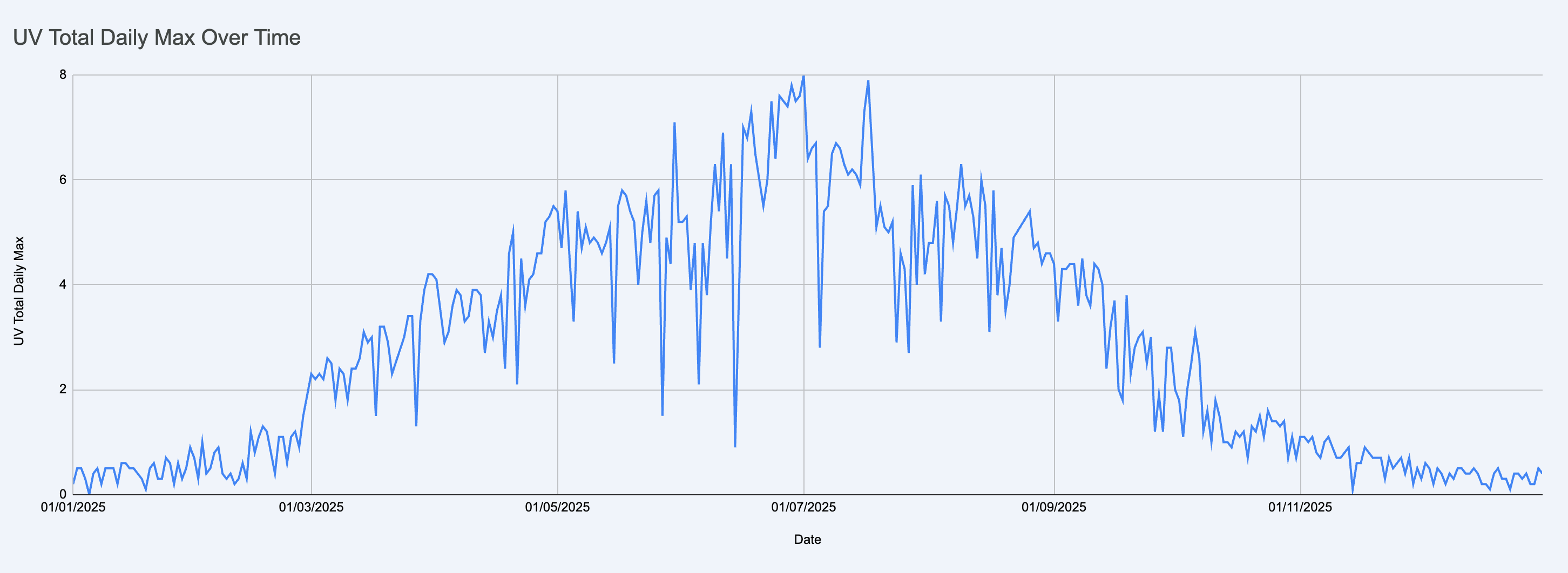
Why, you might ask do you even need sun protection all year round if that’s the case. Habit. It’s as simple as that. Maybe you’re organised enough to switch your vitamin D supplement for daily sun protection on 1 April and switch back on 1 October. I’m not. I supplement vitamin D 365 days a year and I use sun protection on my face 365 days a year.
I have heard time and again that the best sun protection is the one that you wear. And, over the past few months, I’ve become acquainted with what I think is a truly wonderful study that was initially an investigation into how effective sun protection is at protecting against cancer, but actually is a study that tells us so much more than that.
Have you heard of the Nambour Trial? I hadn’t and I feel a bit like I should have done so maybe you know all about it already. Anyway, in the early 1990s, more than 1600 residents in Nambour, a small town in Queensland, Australia were enrolled in a study. Half of them were asked to wear broad spectrum SPF 15+ sun protection every single day (and to reapply after heavy sweating, bathing, or long sun exposure), while the other other half were asked to wear sunscreen in exactly the same way as they previously had, at their own discretion (which often meant using it rarely or never). I read a really interesting interview with one of the women involved in setting up the trial about how they had to use “their normal sun protection” as the control because it would have been unethical to give people dummy sun protection.
Anyway, four and half years later, dermatologists examined each of the participants for skin cancers. The incidence of squamous-cell carcinomas was reduced by 60% in the people using sun protection daily compared to whenever they felt like it. A follow-up study in 2011 found daily sunscreen use in these same participants had almost halved the rate of melanoma.
Now obviously this is a brilliant piece of landmark research because it proves what actually hadn’t been proved before — that sun protection does actually reduce the rate of skin cancer. But the bit that really wowed me was two-fold — one, they weren’t using SPF 50+ they were using SPF 15+ AND when the researchers looked at how much product those in the study were applying, they discovered on average that it was 0.79 mg/cm² — less than half of the 2mg/cm² they’d need to apply to get the amount of protection on the label.
There’s a vaguely linear correlation between amount and protection so if you apply 2mg/cm² of SPF 15, you get SPF 15 protection, but if you apply 1mg/cm² you get about SPF 7.5 so the people in this study were probably effectively getting SPF 6 and it was still protecting them from skin cancer. This blew my mind.
Anyway, let’s be honest, I largely wear sun protection not to prevent skin cancer but because I’m vain and I know that it helps keep you looking younger longer. And, as far as I know, nobody has done the research on the correlation between cancer protection and photoaging protection, so it may be that you do need to wear 2mg/cm² of SPF 50 and religiously reapply it every two hours to get those anti-ageing benefits but, for me, the Nambour Trial validates the idea that just using sun protection — any sun protection, in quantities that are manageable enough not to piss you off, and as frequently as you can — can only be a good thing.
The beauty of space
Between 6pm and 7pm (here in the UK) on Monday, I felt like there were two things going on that seemed to represent both the nadir and the zenith of humanity. On the one hand you had a(nother) press conference that seemed like a fever dream, where the US president used the word “amazing” 20 times, said he’s getting messages from a country under attack saying “Please keep bombing”, and threatened to take out all of Iran’s infrastructure, while Pete Hegseth compared the rescue of a US airman to the resurrection of Jesus. And, on the other you had the crew of Artemis II surpassing the record for the furthest that humans have ever travelled from the earth and passing behind the moon.
Space and space travel continue to absolutely blow my mind. And I’m so thrilled that I have two small children who already seem to share my excitement. Because thinking about the magnitude of space is one of the things that keeps me sane. And seeing humans manage to explore it in the way that we continue to really represents, for me, the pinnacle of the human appetite for knowledge, the human belief in science and so much more.
I know, I know, you’re wondering how all this relates to beauty. Well let me tell you about the number of brands and products I have been told “were first developed by NASA” or are “based on NASA technology.”
The one that immediately springs to mind is Crème de la Mer. The legend of this wonder cream is that it was developed by a NASA scientist, Max Huber, who created it to treat burns he’d suffered as the result of an experiment. Another part of the legend was that each batch of the mysterious seaweed-based Miracle Broth, that was at the heart of the cream, incorporated a sample of the previous broth, and was fermented to a soundtrack of the fermenting process to encourage the next batch to ferment. I mean let’s leave aside the idea of a scientist buying into the concept of fermentation requiring a soundtrack… the whole thing just didn’t seem credible to me. I’ve wanged on before about the piece I wrote about CDLM more than 15 years ago now but I kind of have a particular axe to grind about people hanging on to NASA’s coat-tails.
Because my Dad actually is a NASA scientist.
Years ago I asked Dad to help me get to the bottom of the Max Huber thing. I’d done a search on PubMed and failed to find anything but I asked my Dad to do literature search and see if he could find any reference to Huber at NASA. He found nothing.
Me: Does that mean he didn’t exist? Or didn’t work at NASA?
Dad: Put it this way, it would be very unusual for someone who was a NASA scientist to not have a single bit of published research to their name.
(This Elle piece from about 10 years ago addresses the Huber-NASA confusion — although I know, without question, that while NASA references might since have been scrubbed from the ELC website now, back in the late 90s and early noughties that was definitely the story they were telling. The feature also reveals the wild fact that Estée Lauder’s head of R&D apparently communicated with the late Huber via a psychic (?!), and suggests that the soundtrack thing might be grounded in science.)
But CDLM is just the start. NASA is used a lot in the beauty industry as a by-word for cutting industry tech. And, naturally, the hope is that brands will bask in the reflected glory, regardless of how tenuous the connection. I just trawled through my inbox and I have…
“a new LED face mask, with NASA technology”
“specialist duvets incorporating NASA technology”
“the same instrumentation that was used on NASA’s Phoenix Mars Rover was used by Pantene to better understand haircare product performance”
“the first ever multivitamin developed from joint research with NASA”
beauty technology with “NASA-accredited principles”
a foundation that uses “NASA-inspired technology”
…the list goes on and on.
I don’t do it any more and even back then I was aware it made me a total twat, but for a while, whenever anyone told me that there was a NASA link to a beauty product, I went through a phase of saying “Oh really? That's fascinating, I'll have to ask my Dad about it.” And when they asked why, just casually responding, “Oh, he works for NASA” and watching the blood drain from their faces.
That’s not to say that NASA hasn’t been involved in projects that have been co-opted by the beauty industry. Some of the list above is legit. Although using NASA technology doesn’t automatically mean the products you create with it work, or are any better than your competitors.
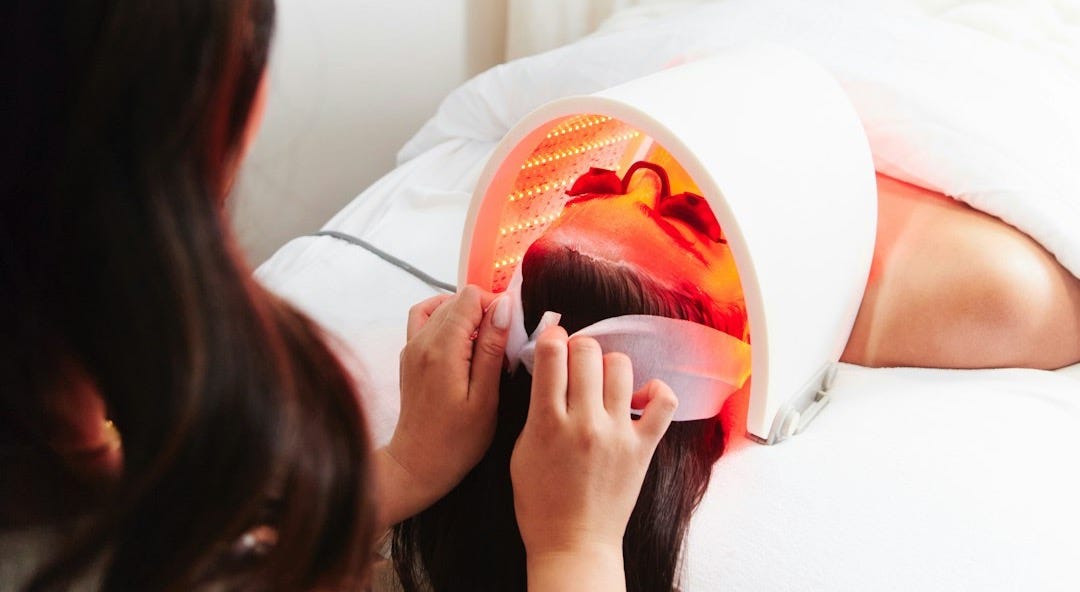
For example, there is credible stuff behind LED masks (although obviously that doesn’t necessarily mean that all LED masks are credible) and behind a bacteria that could have a role to play in sun protection. I’m particularly fond of this last one as it involves a bacteria found at the Jet Propulsion Lab, where my Dad worked, plus some of his work involved planetary protection (ie making sure we don’t contaminate other planets on missions and vice versa.)
(By the way if you’re interested in a more accessible aspect of my Dad’s work, and/or you liked Matt Damon growing potatoes on Mars in The Martian, do have a read of this feature about how, in lockdown, he did a load of experiments in his kitchen with radishes that might pave the way to astronauts cultivating food on the Moon.)
But yeah — space and space exploration: brilliant. Beauty trying to spacewash: less brilliant.
That’s all for this week. Next week, I’ll be digging into Drunk Elephant’s attempts to rehab its reputation and a whole lot more. Until next time…
Note: I only enthuse about products I really rate, but I can earn commission on products I mention here. If you hate the idea of this, please let me know, as this is very much a work in progress and nothing is set in stone.
“Spacewashing” I cackled. In other things I feel like Lauder doesn’t want us to remember is Patrick Ta’s stint as La Mer’s celebrity makeup artist.
“Specialist duvet” is really sending me