

New perspectives geekery...
...including an update to one of last week's stories (mea culpa), a look at what constitutes "normal" when it comes to skin, some chat about "chicken skin", and a different take on perfume...
Finding a title that encapsulated everything I wanted to cover in this newsletter was a tough one. I never really intended every newsletter to be one long read, or even really for the stories to be themed, but that’s sort of how it’s happened, which has made giving them a title relatively easy. But this week it was a bit of a mixed bag as I wanted to sort of course-correct last week’s story on The Skin Diary, tell you a bit about Keratosis Pilaris (the proper name for “chicken skin”) and a new discovery on that front, and also highlight a new fragrance pop-up that takes a slightly different angle on things. Hence new perspectives…

Because of the length of this newsletter, you might be better off reading it in the app or on the Substack website as some email clients will chop it off (if that’s the case, you should be able to click “View entire message” and see the whole thing. But let me know if any problems.)
Also a little note to say that this will be the last “live” newsletter for a few weeks. I’m heading off on holiday and wanted to take a break from writing. So over the next few weeks I’ll be scheduling newsletters that contain stories from the archives (paid subscribers, I’ll be pausing payments until I get back.) I’ll still be keeping an eye on things (I’m fairly rubbish at switching off entirely) so if you have any questions or want to chat, please do leave a comment.
So with all the housekeeping out of the way, let’s get into it…
BTW: some of the links in this newsletter are affiliate links which means if you buy a product through them, I can earn a small amount of commission. This will never influence my opinion on something: I only rave about products I really rate. If you hate the idea of this, please let me know, as this is very much a work in progress and nothing is set in stone (and, for more on my thoughts on affiliate links, click here.)
The power behind the throne
This is a bit of an addendum to last week’s newsletter which was — largely — about The Skin Diary. And, I’ll be honest, it was something that I did think about at the time, but the newsletter was getting so long, I didn’t really feel I had space to explore it.
However, a reader got in touch and flagged that throughout everything, I’d been talking about the dermatologists behind the brand, when actually, because we were talking about a skincare product, there must also be a cosmetic scientist or cosmetic scientists in the background actually formulating the product.
I’m going to paraphrase the comment, because it was part of a broader discussion about dermatologists generally, and not specifically The Skin Diary dermatologists, but it was really highlighting that however much knowledge and experience you have about skin, that doesn’t mean that you know how to formulate a cosmetic product. You can have an understanding that tretinoin is the most studied and most effective anti-ageing ingredient that we have, you might know how to devise a test that shows the efficacy of a retinoid, but that doesn’t mean that you know how to formulate a cream that contains retinol. Or know which of the 24,000 ingredients that you can combine in formulations, you should be combining with it. Similarly you might know that hydroquinone is effective at tackling pigmentation, but not have a clue how to devise a delivery system that ensures it gets to where it needs to.
Without a cosmetic chemist, there’s no product
This isn’t about doing down dermatologists, or saying that they should stay in their lane, it’s more about acknowledging the role of cosmetic chemists. Which I think is really important. So, while I did want to hero the cosmetic chemist behind The Skin Diary, when I asked who it was I was told “We don’t publicly disclose the identity of our cosmetic scientist/formulator, as this is commercially confidential.” Hmmmmm, is it commercially confidential, or would it detract from the dermatologists behind it? Because, from a product point of view, cosmetic chemists are the real rockstars. And I don’t understand why we don’t talk about them in the way that, for example, we talk about the noses behind famous perfumes, or the songwriters behind the best songs. We never assume that Kylie or Miuccia Prada was the perfumer, or that Madonna or Robbie Williams wrote all their own songs, so why aren’t we asking as a matter of course who the cosmetic chemist is when we’re shown a product? (I sometimes do, but not as often as I should.)
So you’re an expert… in what?
Anyway, this whole episode reminded me of something that seems to be coming up quite a lot on social media at the moment. It’s more than a little related to the dermwashing that I have covered recently, but I guess it’s a bit more nuanced than that, because it’s not about people who aren’t derms pretending to be derms, but about people who don’t have authority in a certain area assuming it. It’s someone who might have a PhD in physiotherapy making pronouncements about UV and presuming because they’re Dr So-and-so, nobody will challenge them. (And they’re often right.) But it’s also about people who might be tangentially related to a topic being positioned as experts in it.
I’m not calling out anyone specifically on this but it’s something that Jen Novakovich recently touched on (she is a cosmetic scientist — and doing a PhD in environmental misinformation in beauty)
The thing is, I get how this sort of thing happens. If, say, you’re a journalist writing about sun protection on a very tight deadline and you manage to get hold of a dermatologist in between patients, it’s tempting to ask them questions that might not necessarily fit within their area of expertise. Because, hell, you don’t actually have the time to find the academic whose area of expertise is precisely this. And even if you did, what’s to say that they’d be free? So you ask a practising dermatologist, something that might be better suited to being answered by an environmental researcher or a photobiologist, and the dermatologist might know a bit about this but their information might be out of date, or garnered from the wrong source (because this isn’t their speciality) and so poor studies, and misinformation get inadvertently disseminated.
And so incorrect stories about different types of UV filters being damaging to coral are propagated (I feel like there’s a longer newsletter that I could devote to this entire topic but Jen covers off the basics in that Instagram post above) and a false narrative about how different types of UV filters work in different ways (no, it’s not as simple as mineral filters reflect light and chemical filters absorb it, although I know that until Dr Michelle Wong started talking about it and highlighted, among other things, this paper, that it was a myth I was guilty of parroting.)
But let’s assume that you’re not a journalist on a tight deadline, let’s just assume you’re someone scrolling social media or looking through the internet, how do you know who is the authority figure on something? Well, helpfully, Jen and Michelle have put together an Instagram post on exactly what sort of topics different professionals within the beauty space might be best placed to talk about. It’s below and I hope it helps. Because all of these people are essential in our industry, and some get platformed more than others (or platform themselves) and so I feel like there are a lot of voices that we don’t hear so much of, and last week I was a bit guilty of not highlighting the (anonymous) cosmetic chemist behind The Skin Diary so, mea culpa, and I hope that this helps right that wrong a bit.
“Chicken skin” is normal
You may recall that a few months ago I spoke on a panel at SXSW London with, among other people, Dr Emma Craythorne, and I can’t recall whether it was on that panel, or when we were talking before it, but we started talking about constituted “normal” healthy skin. And I realised that when I think about wanting my skin to look normal and healthy, I want it to be free from hyperpigmentation and smooth and dewy and juicy. And Emma pointed out that actually that’s not the norm for skin of women my age, for most women my age, it’s normal to have uneven pigmentation and lines and wrinkles, and what I’m talking about is an ideal that requires a lot of work to achieve. And I’m not saying we shouldn’t aspire to something more, but I think it’s helpful to have a reality check about what is normal and what is aspirational.
In the same conversation, Emma mentioned Keratosis Pilaris aka KP aka “chicken skin” aka those bumpy bits you often get on the backs of your arms and thighs. She said it was extremely common and according to the British Association of Dermatologists, it’s a completely harmless skin condition that “may be present in half the population. It affects 50-70% of adolescents and approximately 40% of adults.” Basically it means that there’s an excess of keratin blocking the hair follicles, which gives the goose bump effect. And although it’s normal, there are a huge number of products on the market promising to help you get rid of it. Again, there’s nothing wrong with wanting smoother skin on your arms or thighs, but know that if you don’t, that’s neither abnormal nor harmful.

The reason why I was thinking about it was because Ameliorate, a company that’s long been the go-to for individuals with KP, just launched limited edition fragrance versions of their body wash and body lotion. Both contain their LaH6 complex, a blend of lactic acid and hydrating ingredients, which work together to break down dead skin cells and moisturise the skin — a combination that will work well on most dry and uneven skin, but is particularly effective for KP.
Now I’ve always been convinced by Ameliorate — people I rate, such as Nadine Baggott rate it, and the reviews are fantastic. I don’t LOVE that they have a section on their website product pages that is labelled “Clinical Trials” when while they may at some stage have done a clinical trial to prove that their products increase moisture in the skin, it’s fairly apparent — and even declared — that everything else comes from consumer perception panels…
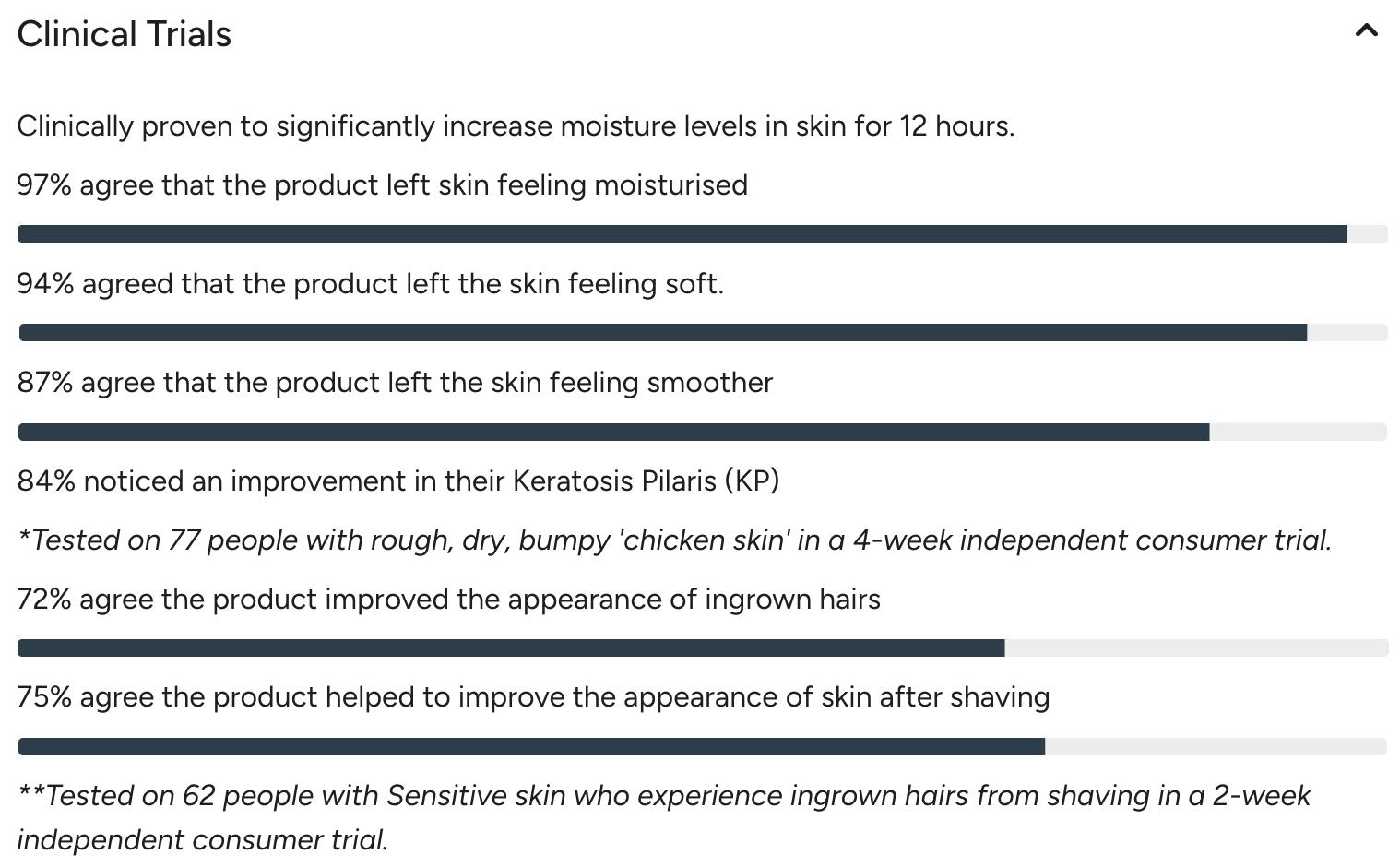
Like I say, consumer perception panels are not nothing, especially when it comes to a condition like KP, but they’re also not clinical trials so…
Anyway, I digress, as I was saying, I’d always liked the stuff in the bottle, but the bottle — or rather the tube — itself didn’t look great. I mean it looked fine, if you didn’t mind something that looked vaguely medical and pharmacy like, but it wasn’t the sort of thing you’d necessarily want on display in your bathroom…
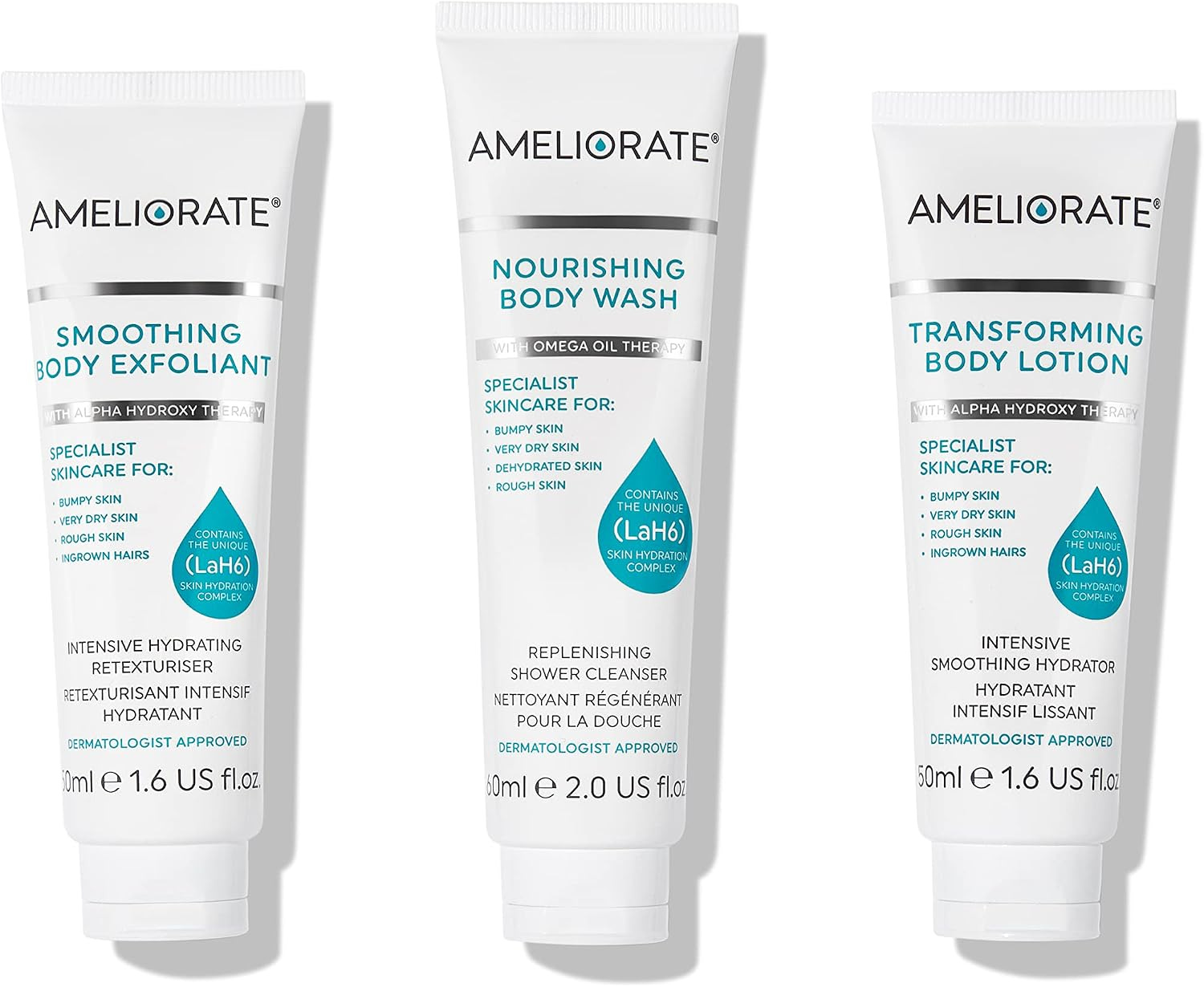
But then last year, they gave the entire range a rebrand and suddenly it looked way more appealing…
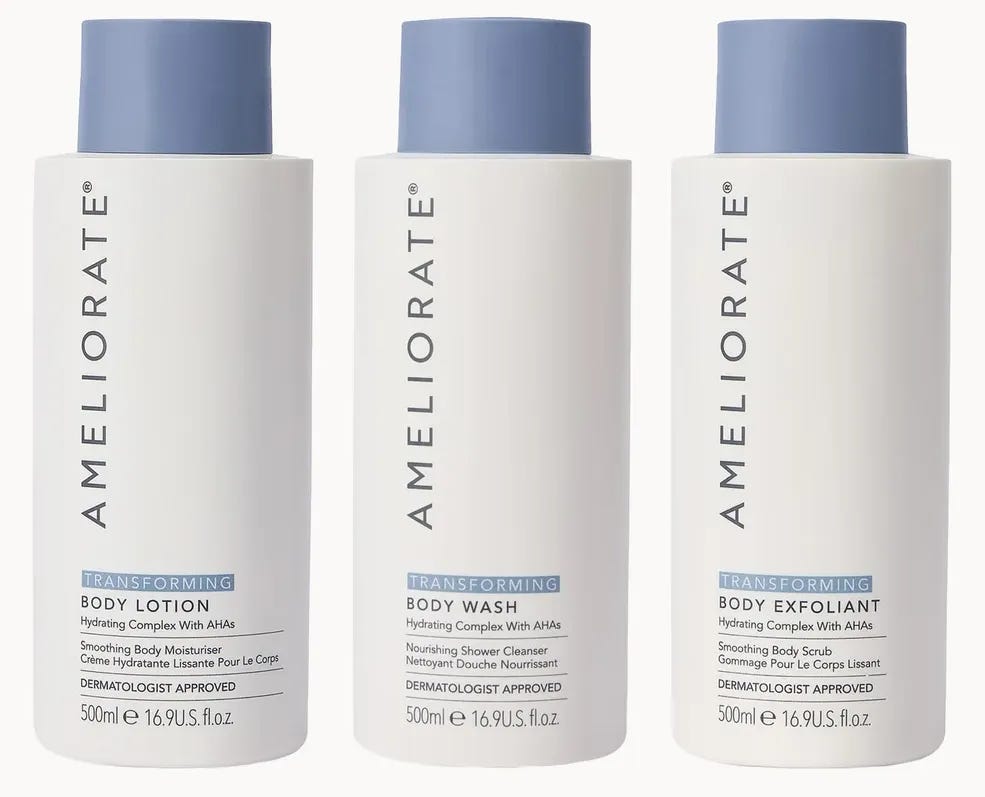
But the other issue that I had with it was that it always smelled a bit. I don’t know how to describe it… yoghurty I think is probably the best description. Which, given that it contains lactic acid is not that surprising. But I just did not love it. And the thing is, AHAs do smell. At a recent launch Caroline Hirons was talking about how active ingredients in skincare, such as her antioxidants and acids, do stink. And a lot of the time, I don’t care. (I think weirdly I don’t mind if my facial skincare smells or feels odd — Skinceuticals CE Ferulic aka thin liquid Marmite is a case in point, but I believe in what it can do for my skin, so I don’t care — but I want my bodycare products to feel a bit indulgent, even when I am expecting them to do something too. I know, it’s not rational, but that’s how it is.)
So imagine my delight when I discover that there is a limited edition Tropical Retreat version of both the Body Wash and the Body Lotion. They’re the same formulas as the originals that gave such great results, but rather than smelling yoghurty, they smell of summer holidays (bergamot, coconut, ylang ylang & bourbon vanilla to be precise, but not as gourmand-y or sweet as the vanilla makes it sound.) I will admit there is a very faint yoghurty undertone to the body lotion but you have to sniff pretty hard to find it
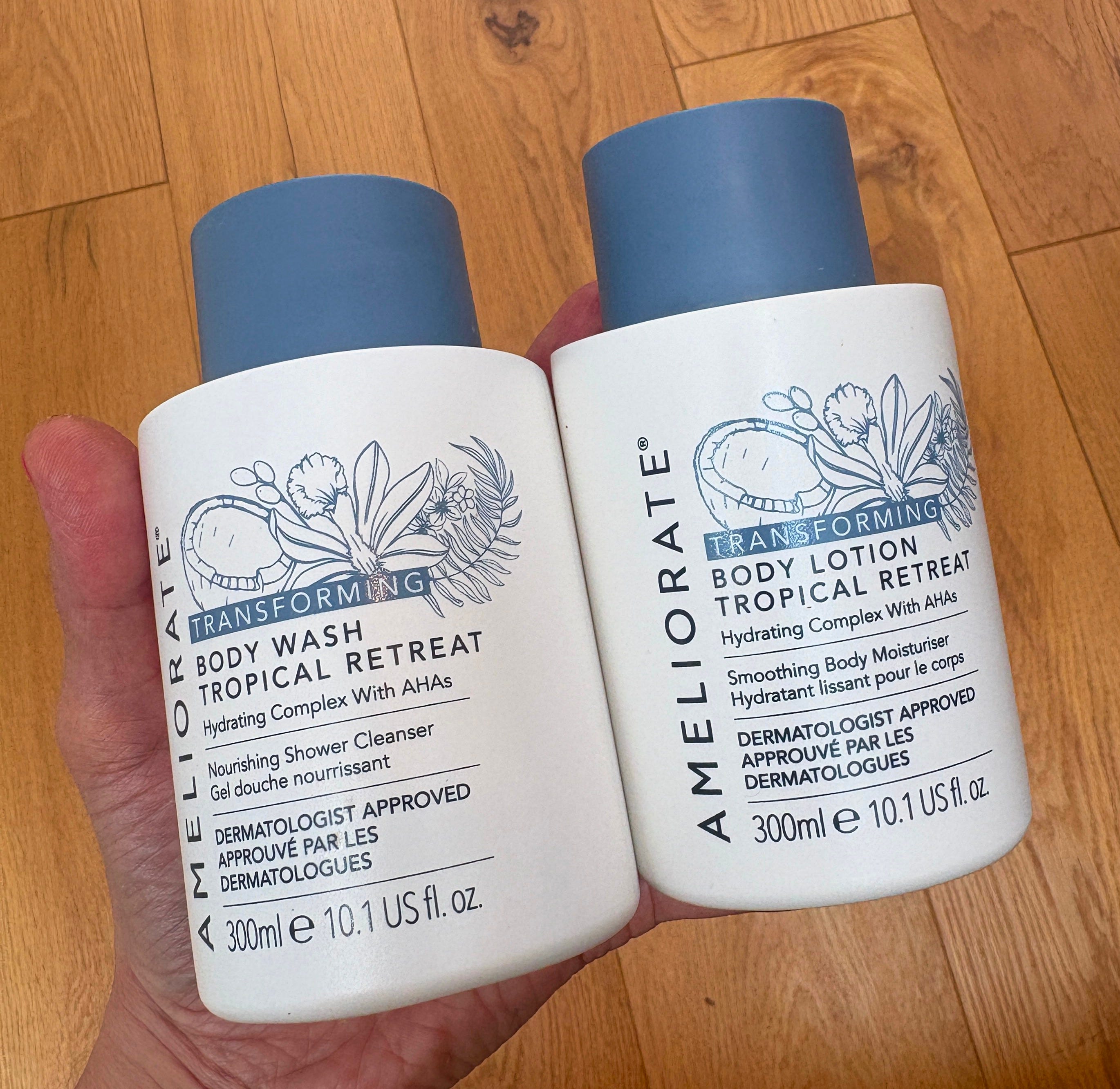
Anyway, if you were taken by the promise of the Grown Alchemist body products that I wrote about back in March but couldn’t quite stomach the price (basically £60 for the pair), then this duo (£31 for the pair) might be a more budget-friendly option — admittedly these are 300ml bottles when the GA ones are 500ml, but still significantly more affordable.
Smell differently
Finally, a little heads up for fragrance fans, or just anyone who is bored of identikit smells. There are lots of things that might grab your attention about Idiom Fragrances — the imagery is just really cool, one of the men behind it is Rob Calcraft, one of the founders of REN who, much as I hate the concept, were clean beauty before clean beauty became the marketing BS it has since become. He then went on to launch Cultured Biomecare, talking about the skin microbiome before we all became obsessed with it. And in March this year, he launched Idiom Fragrances, unpretentious fragrance, designed to be played with and layered — their tagline is “Smell like no one else”. I got tipped off about their latest pop-up which runs in Soho until 26th July and so headed down there to see what it was all about.

There I met Mark O’Shea who has known Rob since the early days of REN, and between now and then has worked with a number of major beauty and fragrance brands, including a stint at Aromatherapy Associates. He talked me through the concept.
“We’ve got seven fragrances that are designed to be worn alone, or layered — layered with each other, or with a fragrance that you already love and wear.”
The fragrances themselves are designed to be straightforward, this isn’t about topnotes and basenotes, the idea is that you read the name of the fragrance, and the three descriptive words and you know what you’re getting.
Acoustic Rose is floral, juicy, amber; Bergamot Hi-Fi is zesty, green, radiant; while Saffron Haze is amber, leather, wood. Sure you can, if you really want, read the small print about rose, apricot, osmanthus and tobacco, but that’s kind of not the point (who knows what osmanthus smells like anyway?)
“We wanted people to get the idea that if they like a floral but want it spicier, they could mix Acoustic Rose (floral, juicy, amber) with Pepper Solstice (spicy, amber, warm).”
The price — £38 for 30ml, £6 for 2ml, £35 for the Discovery Kit with 2ml bottles of all seven — is designed to encourage experimentation.
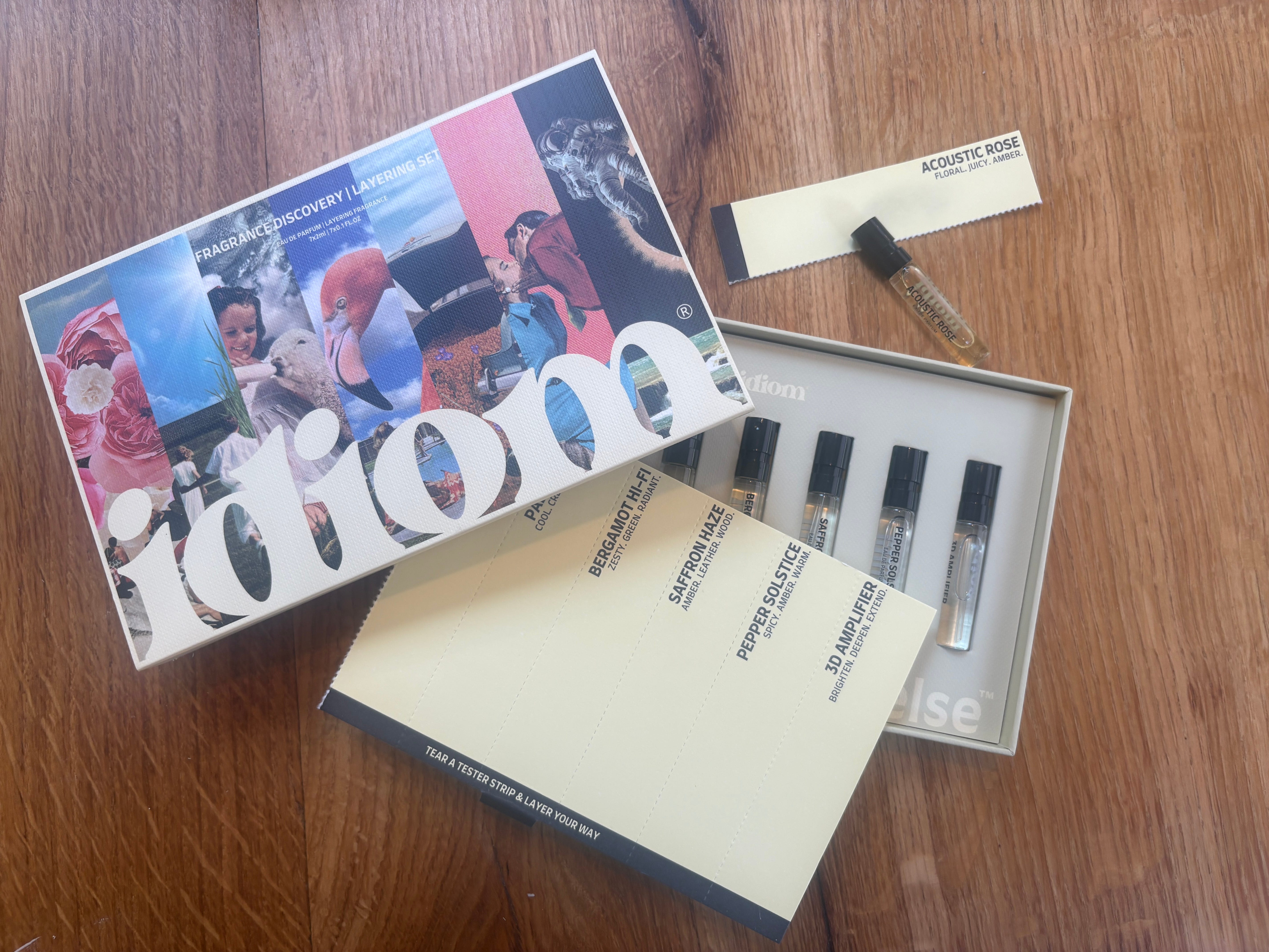
“We could have made 100ml bottles but that makes it less accessible. We also decided to make the bottles without a cap. If you’re paying for the cap, it’s not going on what you’re actually wearing.”
From reading about them, I knew that Saffron Haze (amber, leather, wood) was going to be my bag, but I was also intrigued by 3D Amplifier (brighten, deepen, extend). It can be worn alone and has a sort of clean, warm skin vibe, but, they say, layered under any of their fragrances, or your own, it has an ability to do exactly as it promises, and amplify it. I was fascinated by this because what they’ve done is blend together three of the most well known molecules in the world of fragrance, and three stars of the Escentric Molecules range. There’s Iso E Super — the sole component of Escentric Molecule 01 — Cashmeran — the only ingredient in Escentric Molecule 05 — and Cetalox, which is a slightly more complex form of Ambroxan — which makes up Escentric Molecule 02.
The friend who tipped me off about Idiom, called 3D Amplifier “a weird miracle thing”, saying she was wearing it under her usual perfume and that it had just “switched it up.”
The science of what these molecules actually do is really quite nerdy, it’s down to a number of factors including their ability to hang around a long time, but also in the way that they can change the evaporation profile of the other perfume, and how they interact with olfactory receptors to shift what we’re smelling.
Anyway, from a commercial point of view it’s a no brainer, because you’re not asking someone to walk away from something they already love, instead you’re saying, “Buy this, it will make whatever your own perfume is smell even better (and different from everyone else who is wearing it.)” Because that’s what it does, it’s like turning up the volume, or the intensity of the colours. I am 100% sold.
So are their customers, 3D Amplifier is their second bestseller behind Acoustic Rose. And even as someone not sold on rose usually, I can see why. (Although I might have to reconsider my stance as a non-rose person as I recently finished Phlur’s Rose Whip, which is a woody, musky rose that I adored. Maybe I should be mixing Palo Santal (cool, creamy, woody) with Acoustic Rose…)
As it is, I bought the Saffron Haze, which I do like, and Mark kindly gave me the Discovery Kit too so I’ve been experimenting with the rest of them. And seriously thinking about going back to buy a 30ml of 3D Amplifier to play with under two of my ride or dies, Prada Amber and Escale a Portofino. Who wouldn’t want a technicolour version of something they already love?
I know there are plans afoot for something more long-term, and of course you can buy from their website, but I love getting hands on so if you’re interested, do hotfoot it down to 33 Great Windmill Street before they shut up shop on 26 July.
Right, that’s it both for this week and until later this summer. Whatever you’re up to over the next few weeks, enjoy yourself (and wear sunscreen). Until next time…
Happy Holidays! Some interesting recommendations that I’m going to look into. Thank you!
💯💪💟