

Skin science geekery…
…featuring a brand I really feel is raising the bar when it comes to testing in the beauty industry and an interesting clinical trial…
I’m not in the habit of wanging on about events I’ve been to or stuff I’ve been sent. It’s a part of my job but I also worry it can come across as a bit smug. I’m also not in the habit of devoting almost an entire newsletter to one brand. But sometimes I go to an event, or meet a founder and think it’s justified. That’s the case this week, and — once you’ve had a read — I’d love to know what you think.
BTW: some of the links in this newsletter are affiliate links which means if you buy a product through them, I can earn a small amount of commission. This will never influence my opinion on something: I only rave about products I really rate. If you hate the idea of this, please let me know, as this is very much a work in progress and nothing is set in stone (and, for more on my thoughts on affiliate links, click here.)
I feel like I spend so many of these newsletters boring on about things that are getting on my wick, so this week I am so bloody thrilled to be able to talk about something that I think is genuinely amazing. (For clarity, this isn’t a sponsored newsletter or anything like that, and I hope you know me well enough to know that I wouldn’t enthuse about anything that I wasn’t genuinely convinced about. I am very aware that someone might go out and buy a product with their hard-earned cash because of something I’ve said and I take that responsibility very seriously. Yes, I was hosted at an event and have been given product samples but I go to a lot of events and get given a lot of products, and I don’t rave about them all.)
So, with that disclaimer out the way, I went to an event last week held by a brand called The Skin Diary. You might not have heard of them, they’re not flashy, they’re not in Boots or SpaceNK, they’ve only got two products both of which are pretty pricey and, I’ll be honest, the packaging is a bit meh. But the people behind the brand are genuinely some of the most impressive consultant dermatologists, academics and geeks in the entire industry and so it was obviously a brand that was going to grab my attention from the get-go.

A dermatological superteam
Please let me do you a little intro so you understand the magnitude of these big hitters.
First up, Professor Chris Griffiths OBE — I’ve been geeking out over dermatologist / scientist / academic Chris Griffiths since 2007 when he appeared on the infamous Horizon documentary that catapulted No7’s Protect & Perfect to stardom. On that programme he used a test that he and his colleagues had developed (see “The Manchester Patch Test Assay” below because it is worthy of it’s own separate paragraph) to show that the No7 product was able to restore some of the proteins in UV-damaged skin in a way that has the potential to reverse some of the signs of ageing (wrinkles and loss of elasticity.)
But that high-profile TV appearance aside, his research has been responsible for some of the most important anti-ageing dermatological discoveries in recent decades. He was part of the team that showed the importance of retinoids in repairing older skin, he literally wrote the book on dermatology (he’s the editor in chief of Rook’s Textbook of Dermatology, which is the dermatology textbook), has published more than 850 peer-reviewed papers and is the closest thing geeks like me get to a rock star.
His co-founders are Dr Clare Kiely, a consultant dermatologist, skin cancer surgeon and lecturer in skin ageing and aesthetics at the University of Manchester; Dr Richard Barlow, a consultant dermatologist who was the founding president of the British Cosmetic Dermatology Group and who now specialises in skin cancer and cosmetic dermatology; and Dr Tamara Griffiths, president of the British Association of Dermatologists and one of those rare creatures who is both American board certified and on the UK specialist register for dermatology and also finds time to be the medical programme director for the University of Manchester MSc in Skin Ageing and Aesthetic Medicine. I mean come on, who wouldn’t want to put something on their face that this group has conjured up?


Add in the fact that Beibei Du-Harpur, another dermatologist / academic who I’ve written about before is their scientific engagement lead. Plus the fact that they’ve been working with another University of Manchester academic, Dr Abi Langton, who is working on various long-term projects with No7, both assessing efficacy of their products and as part of a research initiative that’s looking to improve understanding an inclusivity of all skin tones. And finally that they’ve also been working with another of my favourite geeks, Mark Birch-Machin, a professor of molecular dermatology at the University of Newcastle, who has developed a non-invasive way to look at what’s happening in the DNA of your skin cells (and whether your skincare is helping or hindering). And you can, I hope, understand why I’m pretty excited about this brand which is barely three years old. It basically brings together some of the biggest skincare brains in the country.
But while the personnel involved are more than enough to get my attention, what they presented last week was something that had me wanting to stand up and applaud. Given that I’ve only been writing this newsletter since December, I’ve devoted more words than I care to count to what I’m broadly going to call “science-washing”. You know what I mean, it’s the buzzwordification of “clinically-tested” and “science-backed”, the conflation of consumer panel tests and clinical trials, the sheer bloody nonsense of it all that does a disservice to scientists and cedes control to marketing. So Dr Kiely was very much talking my language when she stood up to say:
“There’s a very big difference between talking the scientific talk and walking the walk,” She went on to explain that “clinically proven can mean anything. It can refer to an ingredient that’s been tested on cells in a petri dish and been shown to be effective. But in drug development 90% of the things that work in a petri dish fail in humans. Just because an ingredient can do something doesn’t mean that that translates to a performing product.”
And this is something I’ve talked about before; brands taking manufacturer in vitro (not on real people) tests and just plonking the ingredient in a formulation (hopefully at the same level that the manufacturer tested it at) and just assuming that it will do in real people’s skin in a finished formula what it did on cells in a test tube as a solo ingredient.
“Cell to surface” testing
So yes, I loved this. But what they talked about subsequently I loved even more. The Skin Diary has developed what they call a “cell to surface” testing approach. And honestly, it’s exactly the sort of thing you’d expect a bunch of dermatologist / academics to come up with. It involves testing the final formula at three different levels:
Looking at the cells — this is the petri dish bit; but it’s not individual ingredients in a petri dish, it’s looking at how the final formula impacts gene expression in cells. [A quick aside, don’t get too hung up on the term “gene expression”. As we get older some genes do more and some do less — this is referred to as how these genes are expressed. And the reason why you want to change the way genes express in cells is because you want to help cells work more like they do in young skin than in older skin.]
Looking at clinical trials — but proper clinical trials, randomised ones where you use machines to assess things like wrinkle depth, hydration and UV protection and the people using those machines don’t know what the subjects have been using and whether it was the product or the control.
Looking in the mirror — as Dr Kiely pointed out, there’s no point proving something in a lab if you can’t also see it on your own face, so that’s where consumer perception tests come in. And this is the thing, I’m not against consumer testing, I just don’t think that, in isolation, it tells you that much about the product and its efficacy.

They’re setting the bar high for themselves — and this sort of testing is expensive, which is part of the reason that their products are. But I think having a brand (that for all its big hitters is still a small, indie brand, it’s not L’Oréal or Unilever) showing what’s possible, and setting a standard for others to aspire to can only be a good thing for the industry.
The Manchester Patch Test Assay
While I’d heard this talked about in the past, I don’t think I had a very good understanding of what it was — and why it was so revolutionary — and so hearing Prof Griffiths explain it was really eye opening.
Basically if you want to see if an anti-ageing product works, what you normally have to do is get people to try it for months to see if it changes the proteins in the skin and helps build collagen and elastin, as these are the markers of a product like this “working”. But this test allows you to get an idea of whether a product will work in less than two weeks.
A small punch biopsy is taken from photoaged forearm skin to act as the baseline sample. (The forearm is often used as a proxy for “UV damaged / aged skin” as it tends to get most unprotected sun exposure.) Then, the skincare product is applied to the forearm covered with a protective film. This is reapplied every 4 days for a 12-day period. A new small biopsy is then taken to evaluate the changes in collagen and fibrillin (two of those proteins involved in the structural repair of skin) over the course of those few days.
This was the test that Prof Griffiths demoed in that Horizon documentary, showing that Protect & Perfect could help repair UV damaged skin. And the rest is No7 history.
What about the products?
I know, I know, you’re all like “well this is all very well but show me the juice” — and we’re getting there. The two products are a Moisturising Day Cream with broad spectrum SPF50 (£92) and a Night Repair Therapy (£135). I know, I know, I told you they were expensive didn’t I? I almost don’t want to go into them in too much detail because I fear this might start to sound like an unpaid advert. But they really have stuffed a tonne of impressive ingredients into both of them and — it goes without saying — that both have been tested in this skin to surface way, with undeniably impressive results.
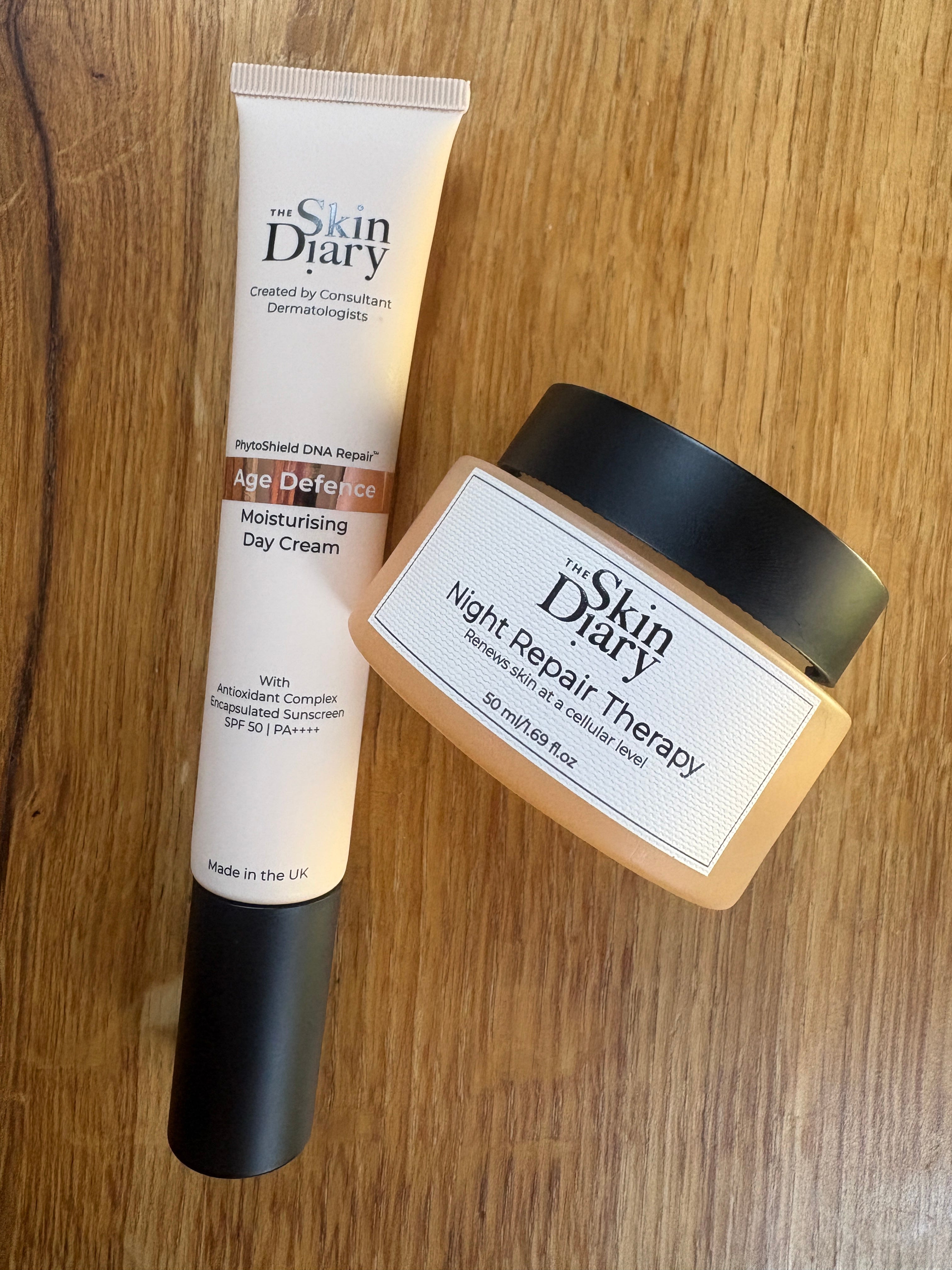
I’ve been using the Moisturising Day Cream as my daily SPF for a while and I really like it. It’s lightly scented, but not overpoweringly so, moisturising without being greasy, and packed with antioxidants and DNA repair enzymes, it uses chemical rather than mineral UV filters so there’s no white cast (plus they’ve encapsulated the filters so they shouldn’t cause issues for sensitive skin), and I haven’t had an issue with it pilling under my makeup. Their tests show that, at a cellular level, it has the ability to reduce UV-induced collagen damage and inflammation by a factor of almost four, and studies on real people show it offers a hydration boost that can still be measured 24 hours later. In short it’s pretty much the perfect SPF, if only it wasn’t so much more expensive than every other SPF I recommend. That said, I think it’s a bit like the Klira Dayscript (more on that later) where you could 100% get away with it being the only thing that you use on your skin in the morning because it has so many other ingredients you don’t necessarily need another serum…
I’ve not tried the Night Repair Therapy yet, but slathering it on for the first time it feels like a really nice night cream — not surprising really, it’s got a load of seed oils in it as well as niacinamide, hyaluronic acid, and — interestingly (to me, at least) — the same peptides (a combination known as Matrixyl) and retinyl palmitate that you’ll find in No7 Protect & Perfect. The Skin Diary tests show that, at a cellular level, it actually outperformed prescription tretinoin (0.025%) when it comes to boosting levels of fibrillin and collagen. (Only they can’t say that because comparing a cosmetic to a prescription drug gets you in all sorts of trouble, so instead they say it’s 20 times more effective than retinol.) Studies on real people show measurable improvements in wrinkle depth. Again, there’s nothing not to love about it — apart from the price.
I wish I had the self-restraint to ditch everything else I own for three months and just use this pair because the befores and afters they showed of people who had used only these two products demonstrated really impressive improvements — not just on lines and wrinkles but also on skin tone and pigmentation, radiance and redness.
The winning combination
These ingredients aren’t unique — you’ll find various combinations of them in any number of skincare products so I was fascinated that they’d decided to use the same peptides (Matrixyl) and the same vitamin A derivative (retinyl palmitate) in the night cream as are found in Protect & Perfect. For a number of reasons. Firstly with any other brand I might have assumed they were piggy-backing on a successful competitor, but with this lot, it would be a bit like accusing a Nobel prizewinner of copying your homework. But I also couldn’t really understand why you’d use retinyl palmitate — an ingredient which is pretty lowdown in the vitamin A hierarchy, especially because, years after the Horizon documentary I was speaking to Mike Bell from No7 about peptides (it might have been around the launch of Future Renew). We were talking about how powerful peptides can be and when I quizzed him as to whether it might have been the peptides making the difference when it came to anti-ageing skin, rather than the retinyl palmitate, he admitted that it could be.
So, obviously, I put the same question to Prof Griffiths, and his reply surprised me. “I don’t think it’s the peptides or the retinyl palmitate, I think they work synergistically.” And, later, discussing it with Dr Kiely, she said that neither the peptides nor the retinyl palmitate would independently give the sort of result that they give together, they are literally greater than the sum of their parts.
Anyway, I thought it was a really interesting evening, both in terms of the people I had the opportunity to speak to (I am 100% pinning down Abi Langton for a chat for this newsletter in the near future as she is a proper fount of geeky testing knowledge and is right at the cutting edge of what we are able to do when it comes to analysing efficacy), the aspiration that The Skin Diary has to raise the bar within the entire industry when it comes to testing, and what I learnt from all those dermatology brains. And I hoped at least some of this might interest you too. As ever, let me know in the comments.
Why your sun protection also needs an antioxidant
I mentioned Klira Dayscript above and the reason I wanted to talk about that was because a study was recently presented at the British Association of Dermatologists Annual Meeting 2026 which suggests that daily use of an SPF 50 with antioxidant technology can help protect human skin from ageing better than an SPF alone.
The product — let’s call it Klira Dayscript because there’s absolutely no reason why the Klira PR would have sent me this study in the same email that contained all the information about Dayscript if it wasn’t actually Dayscript — was tested on real people and Mark Birch-Machin’s Skin Life Analytics company (the same one that tested The Skin Diary’s SPF to show its impact on collagen damage etc) looked at the impact on damage to mitochondrial DNA (more damage is associated with sun-exposed skin and photoageing.)
The upshot was that adding antioxidants to SPF gave better results than using an SPF on its own. I’ll be honest, this isn’t wholly surprising. We know that SPF alone doesn’t stop all UV getting to the skin and, as such, doesn’t protect from all UV damage. It’s part of the reason why I’m such a fan of antioxidants, they can help pre-emptively protect skin from UV damage, and also help to repair it. That’s why I’ll always layer an antioxidant under my SPF. But I get that not everyone wants to do that because it’s another step in the routine so if you’re not up for faffing, picking up a product that already contains antioxidants — such as Klira’s Dayscript, The Skin Diary’s Moisturising Day Cream, or even Prime Forever’s antioxidant-packed SPF50 Primer — means you’re getting more bang for your buck than you would if you just used a broad spectrum SPF50.
I also think it’s worth using multiple antioxidants. (Or, more accurately, products that stack multiple antioxidants.) We now understand about broad spectrum sun protection and using a range of filters that can protect us against different types of UV light, but I also think we need to think about using a range of different antioxidants because different free radicals require different antioxidants, and I’m expecting that to increasingly be a focus in years to come.
That’s all for this week. As ever, let me know your thoughts on any of this in the comments. Until next time…
That is fascinating! Very tempting, as you say, to buy and try. My skin is great at the moment but at 61 I wonder if it could be better (firmer, definitely). Thank you as always for the science. X
I’m so lazy but I do manage to do spf all the time now, a couple of bcc’s on the face will do that for you! I am tempted by the credentials on these.