
Bodycare geekery
...how bodycare upped its game, and how brands I really didn't expect to are using that shift to boost their science credentials. Plus the truth about affiliate links — the good, the bad, the ugly...
The body care revolution
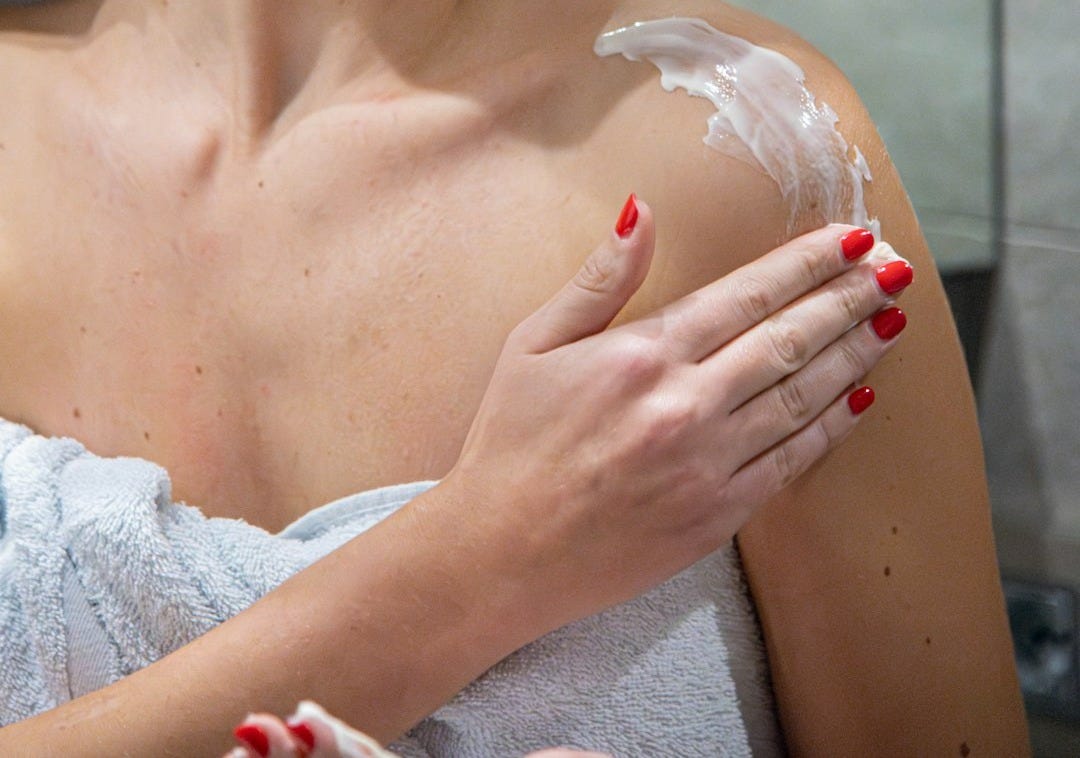
I am so pleased to see body care finally getting the same sort of attention that facial care has had for years. Although it’s taken a while for it to become properly mainstream. While researching this piece I found an email to a commissioning editor that I wrote in 2018 that included the following pitch:
“Not sure if this is any more than a cols off [newspaper speak for a short feature that will sit alongside a spread] but I think finally beauty brands are getting the message that women want decent actives in their body care too. DCL have a Vitamin C body cream and REN just launched an AHA body cream - maybe looking at the key actives we know work - incl retinol, and niacinamide etc and finding the products that have them in.”
And it was a year after that that I finally got the piece commissioned. So in a way it’s wild that the best part of a decade later, I’m still wanging on about it.
But as I’m seeing more and more body products out there — and interestingly, body products that have been tested in the way that I always harp on about skincare products being tested, but more on that later — I thought it was worth dwelling on.
A friend of mine asked me YEARS ago why actives, such as retinoids and AHAs weren’t in body products and back then the only reason I could think of was that it would make them really expensive. In 2019 when I spoke to Prudvi Kaka, beauty brand Deciem’s chief scientific officer, she pointed out (in a way that tells you quite why I have loved Deciem for so long — these people speak my language): ‘the average surface area of the body is 15670cm² and requires 7.82g of product a day, whereas, for face, the average skin surface area is 565cm² only and requires 1.54g of product a day.’
So yes, you’re going to need a bigger tube, and more of the active ingredient, but it also means you’re getting a bigger dose of active ingredients and if, for example, you’re pregnant, you might want to avoid using a retinol-based body cream because of the theoretical risks of vitamin A on the foetus. (Large doses of vitamin A have been linked with birth defects, but there’s no evidence that using a retinoid topically does the same but it’s usually avoided during pregnancy out of an abundance of caution.) But generally, I feel like actives in bodycare are, for most people, a good thing.
I recently spoke to Dr Eleanor Bradley from No7 about them extending the Future Renew franchise into bodycare — and she made the point that there was both consumer demand for this, and that there’s a scientific argument around it too: if you want to tackle signs of ageing and sun damage, why would you limit yourself to just those on the face when they are also apparent elsewhere.

The thing that I’ve found really interesting is seeing brands that I would normally have thought of as just creating “nice to use” body products really seizing the opportunity that bodycare with actives is offering, and almost relaunching themselves and repositioning themselves in the process.
Take Bronnley for example. You think of Bronnley and you think of royal warrants and nice soaps that your grandma used to use, right? English Fern, Lavender, Lily of the Valley, and that gorgeous, zesty Lemon one, the exact shape and size of an actual lemon. I’m fairly sure my grandma used to keep them in her underwear drawer “to keep my smalls smelling nice.” Anyway, I had completely forgotten about them until their PR sent me the Lemon collection, which includes a hand cream. I tried it, and it felt like a nice hand cream — you don’t need much as there’s glycerin, apricot oil and shea butter in there that do a good job of moisturising and it has that lovely uplifting, slightly powdery, lemony scent.
But then I saw that it wasn’t just a hand cream. Oh no this was a Brightening Hand Balm (£17) that contains 5% niacinamide. Now this is a concentration that has been shown to be effective at improving a number of skin parameters including fine lines and wrinkles, hyperpigmentation, blotchiness, sallowness and elasticity. Already I’m sitting up and noticing because I was not expecting Bronnley to be jumping on a) the actives bandwagon and b) the percentages bandwagon.
But they have. And they’ve also jumped on the trial bandwagon. I KNOW. Admittedly this is a consumer trial (“people tried it and we asked them what they thought” rather than a controlled clinical trial “some people tried it, some people didn’t and we asked instruments / experts who didn’t know who had tried it and who hadn’t what they thought.” And while I think consumer trials are important — what’s the point in showing something has changed under a microscope if you can’t see with your own eyes that it’s changed? — I also think that unlike instruments or blinded experts, people who are being studied may be swayed into thinking they see improvements because they like the product / the brand / the researchers and results can also be skewed by the way in which questions are asked. All that said, I know controlled clinical trials are expensive so I get why, if you’re a bodycare brand whose entire focus isn’t science, you might just ask an independent company to carry out a consumer trial. Which is what Bronnley did.
51 people aged 20-60 — approx 50% Fitzpatrick skin type I-III and 50% Fitzpatrick skin type IV-VI — using the product for four weeks, at least three times a day. Let’s ignore the results for softening and moisturising because honestly if you’re a hand cream that’s literally the least I expect of you. But apparently 94% felt that their hands looked, healthier, brighter and more even in tone after the trial, and 92% thought the product had visibly improved the radiance of their hands more than any other they had used. But the result that I was really interested in was the one that looked at “20-30% of the participants who had visible hyperpigmentation on their hands” — now, bearing in mind that there were only 51 people in the whole study, 20-30% is roughly 10-15 people so a relatively low number. But 92% of them agreed that their hyperpigmentation and dull areas were less visible.
It’s not a perfect trial, but the fact that BRONNLEY are talking actives and percentages and trials at all is fascinating to me. And it’s not just Bronnley using bodycare to reinvent themselves a bit, there’s also Grown Alchemist.
Full disclosure, I’ve done some consulting work for Grown Alchemist in the past and so I know that they have a lot more science behind them than you might think at first glance. But before I worked with them I’d kind of put them in the “posh bodycare” box — y’know, along with the Aesops and the Malin+Goetzes of this world — super aspirational, smell divine, I’ll happily have that stuff in the shower making my bathroom look and smell good but probably wouldn’t use their skincare if I actually wanted to get shit done.
But since Anna Teal (ex No7, Aromatherapy Associates) took over in 2023, there’s been a really concerted effort to reposition the brand as a more science-led proposition. Their latest launches, two body products — a Resurfacing Targeted Body Cleanser and Resurfacing Targeted Body Lotion — both have, among other ingredients, a blend of acids in them and are basically designed to be the sort of all-round, exfoliating-yet-gentle-enough-to-use-daily good eggs that will do everything from helpin g with spots, ingrown hairs, and keratosis pilaris (that sort of chicken skin you often see on the backs of arms) to improving skin texture, tone and moisturisation.
And they’ve done the tests to show it — both consumer trials and clinical trials. They also tested each product separately so you don’t have to buy both to see the effects that they are claiming. Admittedly the clinical trials didn’t have a control and were quite small. 33 people for the body wash and 36 for the lotion — a range of skin types (Fitzpatrick I-VI) and around two-thirds of the testers had sensitive skin — but the results, based on being used once a day for four weeks, are good — particularly for the body lotion.
After four weeks of using the body lotion daily:
skin texture had improved by an average of 22%, and almost all testers (97%) showed some improvement in their skin texture;
skin hyperpigmentation improved by an average of 15%, and 75% showed improvement in their skin tone evenness;
blemishes were reduced by 22% and every single person who took part (100%) showed some reduction in their skin imperfections.
I’m sure there are products out there that could give better results but kudos to Grown Alchemist for doing the research and creating body products that look good, feel good, smell good (read more on that next week) and clearly perform.
I’m so bad at using body cream that I have to leave it in the shower and apply on wet skin (not such. terrible thing as the occlusive ingredients can help trap more moisture on the skin) or I just don’t do it. The first time I used these two, I was idly caressing my arm later that night wondering why it felt so soft and then I remembered. But who cares what I think? Their clinical trial shows it’s effective when n=30+ not just 1.
The affiliate conundrum
Loads of people restacked this post (also linked below) last week that riffed off a New York Magazine article where a Fashion Substacker said she made $127,000 a year from subscriptions and $148,300 from brand partnerships.
The post is a brilliant analysis of what I see happening a lot — not just on Substack but on other platforms too. People appear to be successful and then promise to tell you how to be successful (which involves you paying to find out how they are successful and thus making them more successful) and it all just feels like a pyramid selling scheme.
Anyway I thought it was — in many cases — bang on, but it also made me feel a bit uncomfortable. Do have a read of it (and then come back here.) So why did it make me squirm a bit. Well, I can promise you that it’s not because when it comes to BeautyGeekery, “eventually the goal is for it to feel less like a newsletter and more like a retail environment.” But because I use affiliate links. And I’ve never been entirely sure that that’s the right thing to do. Until I started my newsletter, I had never used affiliate links. (For the uninitiated, affiliate links are embedded links that take you to a product or a page. If you go on to buy something, it won’t cost you any more but the person who created the affiliate link gets a small percentage of it.) Now, my background is in newspaper journalism. I strongly believe that line attributed to George Orwell, that “Journalism is printing something that someone does not want printed. Everything else is public relations.” I never saw it as my job to play nice with beauty brands, as far as I am concerned, my loyalty lies with the person who is putting their hand in their pocket to buy a newspaper, or more recently, has trusted me enough to follow me on Instagram.
As a result, for a very long time, I was utterly resistant to the idea of anything that looked like advertising, sponsorship or endorsement. When I launched my Patreon, I even made a virtue of it being #NoAds #NoSpon. As ever, no shade on those that do this, some of my best friends etc etc. But it was of paramount importance to me not only that my opinion could not be bought, but that it could not appear to be bought. How, I wondered, could I honestly take money from a brand for a partnership, even if broadly speaking I liked the brand, and then slag off their launch if I didn’t think it was any good? (I mean this is all VERY hypothetical, I can count on less than half a hand the number of brands that have approached me about partnerships.)
So what changed? Well, when last year, it became apparent that full-time journalism wasn’t going to be a viable career option going forward, I started to think seriously about what I was going to do instead, and started talking to all sorts of people about my options.
And the one thing they said — almost without exception — was that I’d be crazy not to use affiliate links. They told me that literally everyone does it, that as long as you’re transparent about it, nobody cares, and that it was never going to make me millions but if someone bought something because I recommended it, why shouldn’t the brand tip me as it were? And so I started to use affiliate links.
And even though I know what my boundaries and personal code of conduct are — I’ll never recommend a product I don’t rate, I’ll always make it clear that links are affiliate links and, as I say in the footer of every email, I’m not wedded to the idea of using them so if people hate them, tell me and I’ll ditch them — I can see how it could be seen as the sort of slippery slope that that post I referenced above talks about. The platform that I use for the affiliates shows creators the brands offering the highest rates of commission — as much as 66% in some cases (for reference, the highest commission rate any of my affiliates is 21% and most are somewhere between 6% and 15%) — I can see how someone not wildly scrupulous could be lured into promoting products for cash. (For the record, since I started using affiliate links in December, I have made $34 from them. This is not my route to riches.)
As for the other steps in the playbook that that post references, I can tell you I’m vehemently against the sort of stealth ads that it talks about. And I can’t imagine it’s ever going to happen, but if a brand wants to pay to be in one of my newsletters, I will never pass it off as editorial. I get riled enough by the advertising-posing-as-editorial that I see All. The. Time. on Instagram. As for the idea that I would sell BeautyGeekery’s mailing list to the highest bidder? Nah, never going to happen.
All that said I did also see this take on it — see below — which I thought was equally interesting, and made me think about the way that there seems to be a lot of shame attached to women who express a desire to earn money — especially in the creative industries.
But I digress… what do you think? You’re the person I’m writing this newsletter for. I know that I say every week in the little bit at the bottom, “if you don’t like it, let me know” but I figure I should make it easier for you. So the poll is below, let me know what you think. Maybe you don’t care, maybe you trust me, maybe you actually like the idea that I get a tiny bit of Big Beauty’s cash when you buy something I’ve recommended. But on the other hand maybe, despite everything I’ve said, you think it muddies the waters, and makes my recommendations less credible. Either way, let me know your thoughts… results in next week’s newsletter. Until then…
Note: I only enthuse about products I really rate, but I can earn commission on products I mention here. If you hate the idea of this, please let me know, as this is very much a work in progress and nothing is set in stone.


Affiliate links are fine. They’re only not fine if they aren’t labelled in the piece somewhere as affiliate links. Martin Lewis moneysavingexpert is often ranked as the most trusted man in Britain and he uses them in his newsletter, so that makes them a-ok in my eyes.
Thanks so much for the mention Claire! For what it’s worth from a brands perspective, the affiliate links matter, particularly when it’s from credible people that can help give “weight” to a brands narrative vs a general reach approach. I’ve always seen it through the lens your credibility is earned by being selective and with clear points of view that you build over time. so if you agree to work with a brand it’s a compliment. As long as the consumer/reader can clearly see it’s an affiliate link I personally don’t see the issue x